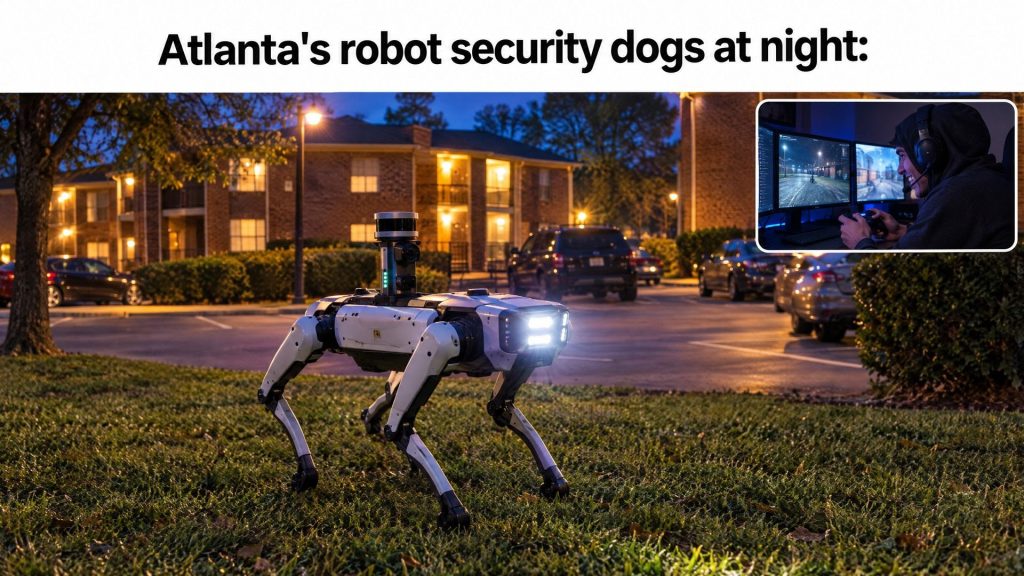

Robotic security technology is moving from science fiction into everyday life. At an apartment complex in Atlanta, Georgia, robot dogs are reportedly replacing traditional nighttime security guards, raising questions about the future of property security, artificial intelligence, and human employment.
Two robotic security dogs have been deployed at 445 Cleveland Apartments in southwest Atlanta, where they patrol the property during nighttime hours. According to reports, the robots have taken over duties previously handled by two or three human security guards.
The development highlights how robotics and remote monitoring technologies are changing security operations across residential and commercial properties.
How Robot Dogs Are Providing Security in Atlanta
Unlike fully autonomous robots, the security dogs at 445 Cleveland Apartments are operated remotely by human controllers.
Each robot can patrol designated areas while an operator monitors its surroundings and determines when intervention is necessary.
The system allows remote operators to:
- Monitor apartment buildings and parking areas.
- Patrol locations where security incidents may occur.
- Communicate directly with residents or visitors.
- Observe suspicious activities through onboard cameras.
- Contact law enforcement when necessary.
- Support property surveillance without requiring a guard to be physically present.
The robots combine mobility, camera-based monitoring, and remote communication to provide an alternative to traditional security patrols.
Remote Operators Control the Security Robot Dogs
One of the most interesting aspects of the Atlanta robot security program is that the machines are controlled by people working remotely.
According to a Fox 5 report, an operator managing one of the robots was based in Bogotá, Colombia.
The operator reportedly compared controlling the robot to playing a video game.
This approach allows security personnel to monitor properties from different locations without being physically present at the site.
Although the robots may appear autonomous, important decisions—including communicating with residents and contacting police—remain under human control.
This distinction is important because the deployment demonstrates remote-controlled robotic security rather than a completely independent AI security system.
Atlanta Robot Dogs Go Viral on Social Media
The robotic security dogs recently attracted attention after a video of them patrolling the apartment complex circulated online.
The footage showed the machines moving around the residential property and interacting with people.
The person who posted the viral video commented that the robots appeared to communicate with residents using Indian accents.
The unusual appearance and conversational capabilities of the machines quickly generated discussion about whether robot security guards could become common in residential communities.
For some observers, the technology represents an innovative approach to public safety. Others have raised concerns about privacy, surveillance, and replacing human security workers.
Who Makes the Robot Security Dogs?
The robots are associated with Undaunted, an Atlanta-based startup developing robotic security solutions.
The company is positioning its technology as a potentially more affordable alternative to traditional security services.
According to Undaunted, robotic security operations can cost approximately half as much as employing conventional security guards.
However, detailed financial information supporting that comparison has not been publicly established in the reporting.
The actual savings may depend on several factors, including equipment costs, maintenance, remote operator salaries, connectivity, insurance, and the number of properties being monitored.
Why Did the Apartment Complex Replace Human Guards?
The property management team reportedly introduced robotic security patrols partly because of concerns about confrontations involving traditional security personnel.
According to the property manager, human guards were sometimes reluctant to approach groups gathering in the apartment complex’s parking areas.
The robotic dogs can instead be directed toward these situations while their operators remain at a remote monitoring station.
This approach may reduce certain physical risks faced by security personnel.
However, robotic security systems also have limitations. They cannot necessarily provide the same emergency assistance, physical intervention, or judgment as trained on-site security professionals.
Are Robot Security Dogs Effective at Preventing Crime?
Undaunted’s CEO has reportedly claimed that residential burglaries at the property dropped to zero following the introduction of robotic security.
However, Reuters was unable to independently verify the company’s crime-reduction figures.
Therefore, the reported decrease should be treated as a company claim rather than confirmed evidence that the robots prevented burglaries.
Measuring the effectiveness of robotic security requires reliable information about crime rates before and after deployment, patrol coverage, emergency response times, and resident experiences.
While mobile surveillance technology may help deter certain activities, its effectiveness depends on how it is deployed and monitored.
Benefits of Robot Dogs for Residential Security
Robotic security systems offer several potential advantages for apartment complexes, office buildings, warehouses, and commercial properties.
1. Lower Security Operating Costs
Remote-controlled robots may reduce the need for multiple on-site guards, potentially lowering labor-related expenses.
2. Reduced Physical Risk
Security operators can investigate potentially dangerous situations remotely rather than approaching them in person.
3. Mobile Surveillance
Unlike fixed security cameras, robotic dogs can move through parking lots, walkways, and other accessible areas.
4. Remote Monitoring Capabilities
Security personnel can supervise properties from centralized monitoring facilities, including locations in other countries.
5. Scalable Security Operations
Property managers may be able to expand monitoring coverage by combining robotic patrols with existing surveillance infrastructure.
These advantages could make robotic security attractive to organizations seeking alternatives to conventional patrol services.
Challenges and Privacy Concerns Surrounding Robot Security
Despite their potential benefits, robot security dogs also introduce important challenges.
Privacy and surveillance: Residents may be concerned about continuous camera monitoring and how recorded footage is stored or shared.
Employment impact: Replacing traditional security guards with remotely operated machines could affect demand for certain on-site security jobs.
Technical reliability: Robots depend on functioning hardware, connectivity, power systems, and remote operators.
Emergency response: Robotic patrols cannot automatically replace the physical assistance provided by trained security professionals.
Accountability: Property managers and technology providers must establish clear responsibilities for incidents involving robotic security systems.
Addressing these concerns will be essential as robotic surveillance becomes more widely adopted.
Will Robot Dogs Replace Human Security Guards in the Future?
The Atlanta apartment deployment offers an early example of how robotic security could transform the industry.
Rather than eliminating human involvement entirely, the technology changes where security personnel work and how they perform their duties.
Remote operators continue to make decisions, monitor situations, and communicate with residents, while robotic machines provide a physical presence at the property.
Over time, improvements in artificial intelligence, computer vision, robotics, and connectivity could make these systems more capable.
However, the widespread adoption of robotic security will likely depend on cost, reliability, legal requirements, public acceptance, and demonstrated safety benefits.
Conclusion
The introduction of robot security dogs at 445 Cleveland Apartments in Atlanta represents a notable development in residential security technology.
By replacing some traditional nighttime security duties with remotely controlled robotic patrols, the apartment complex is testing a different approach to property monitoring.
Although the company behind the technology claims lower costs and improved security outcomes, independent evidence is still needed to evaluate its effectiveness.
As robotics continues to advance, the Atlanta deployment raises a broader question: Will the future of residential security rely on human guards, robotic patrols, or a combination of both?
Source: Reporting attributed to Fox 5 Atlanta and Reuters in the original news summary. Cost savings and crime-reduction figures are company claims that have not been independently verified.