
Introduction: The Problem with One-Click Customer Service AI
Artificial intelligence is transforming customer service, helping businesses respond faster, automate repetitive tasks, and improve customer experiences. However, there is a fundamental difference between answering a simple consumer question and resolving a complex issue for a business customer.
In business-to-business (B2B) environments, customer problems rarely belong to just one team. Resolving a single request may require input from sales, finance, technical support, account management, operations, and external partners. Each team brings different information, responsibilities, and priorities to the process.
This is where the coordination gap in AI-powered customer service becomes apparent.
Many AI tools are designed to handle individual interactions from beginning to end, ideally without human involvement. While this approach can work well for straightforward requests, it becomes less effective when customer issues require collaboration, shared context, and human judgment.
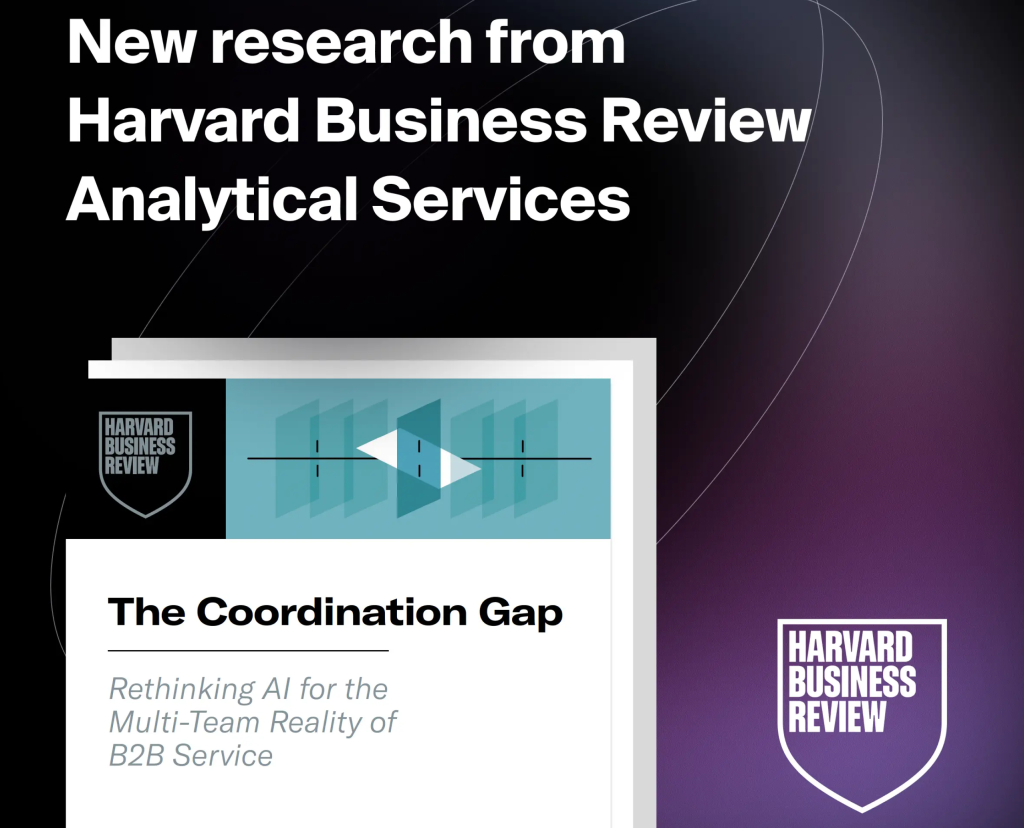
A Harvard Business Review Analytic Services briefing paper, sponsored by Front, examines this challenge and explores why businesses need to rethink how they evaluate AI for customer service.
The central lesson is important: successful B2B customer service is not just about automating responses. It is about coordinating people, information, and decisions to deliver better outcomes.
What Is the Coordination Gap in AI?
The coordination gap describes the mismatch between what many AI customer service tools are designed to do and what complex B2B support actually requires.
Traditional customer service automation often focuses on individual interactions. A customer asks a question, an AI system provides an answer, and the interaction is considered complete.
B2B support follows a different pattern.
Consider a business customer experiencing a problem with a software subscription. Resolving the issue might require a support specialist to investigate the technical problem, a finance team to verify billing information, an account manager to understand the commercial relationship, and an implementation team to check the original setup.
Even if AI can answer each team’s individual questions, the customer may still experience delays if the information is fragmented or responsibilities are unclear.
The problem is not necessarily a lack of intelligence. It is a lack of coordination.
Effective AI for B2B customer service must therefore support shared visibility, connected workflows, and collaboration between people and systems.
Why B2B Customer Service Is Different from Consumer Support
Consumer support and B2B customer service share the same broad objective: helping customers solve problems. However, their operational requirements can differ significantly.
| Consumer support | B2B customer service |
|---|---|
| Often handles straightforward, repeatable questions | Frequently manages complex, interconnected issues |
| May involve one agent and one customer | Can involve multiple teams and stakeholders |
| Often prioritizes speed and transaction completion | Balances speed, accuracy, relationships, and business impact |
| Many interactions can follow standardized workflows | Workflows may depend on account context and individual circumstances |
| Automation can resolve many routine requests independently | AI often needs to assist human decision-making and coordination |
For a consumer asking about a delivery status, an automated response may be enough.
For an enterprise client reporting a service disruption affecting several departments, an automated answer is unlikely to solve the entire problem. The organization may need to investigate the cause, coordinate technical resources, communicate updates, and agree on a resolution.
This distinction explains why businesses should not evaluate AI tools solely on the number of conversations they automate or the percentage of requests they deflect from human agents.
They must also consider whether AI improves the complete customer support process.
Why Businesses Struggle to Scale AI Beyond Pilot Projects
AI adoption in customer service is attractive because the potential benefits are easy to understand: faster responses, reduced manual work, greater operational efficiency, and improved customer satisfaction.
Yet moving from a promising pilot to a dependable, organization-wide solution can be difficult.
Several challenges commonly stand in the way.
1. Fragmented Customer Information
Customer information is often distributed across CRM platforms, help desks, email conversations, billing systems, project management tools, and internal communication channels.
When AI cannot access the relevant context, it may produce incomplete answers or miss important details about the customer relationship.
Connecting systems and maintaining reliable information flows are therefore essential to useful enterprise AI.
2. Unclear Ownership of Customer Issues
Some customer problems do not fit neatly into a single department’s responsibilities.
Without clear ownership, requests can be transferred repeatedly, teams may duplicate work, and customers may need to explain the same problem several times.
AI should help identify the appropriate owner, organize relevant information, and make the next action clear rather than simply generate another response.
3. Automation Without Accountability
Automated responses can improve efficiency, but they do not automatically create accountability.
When an issue requires approval, an exception, or a judgment call, the organization still needs a clear decision-maker. AI systems must support appropriate escalation and preserve the context that human teams need to act.
4. Measuring the Wrong Outcomes
A customer service team may report success because response times have fallen or more tickets are resolved automatically.
However, those metrics do not necessarily reveal whether complex problems are being solved faster, whether customers are satisfied, or whether account managers are spending less time coordinating internal teams.
Businesses need to measure the quality and effectiveness of the entire service journey, not just individual interactions.
Four Common Failure Modes of AI in Multi-Team B2B Support
When AI tools designed for single-agent interactions are introduced into complex business workflows, four recurring problems can emerge.
Failure Mode 1: Losing Visibility Across Teams
If customer conversations and decisions are scattered across separate systems, no single team may have a complete picture of the issue.
An AI assistant might generate an accurate answer using the information available to it while overlooking a recent decision made elsewhere in the organization.
The result is inconsistent communication and unnecessary delays.
What businesses should do: Prioritize shared context, accessible conversation histories, and clear visibility into issue ownership and progress.
Failure Mode 2: Treating Every Interaction as an Isolated Task
Complex B2B problems rarely end with one message. They evolve as new information arrives, stakeholders contribute, and decisions are made.
Tools that focus exclusively on closing individual conversations may fail to support the full lifecycle of a customer issue.
What businesses should do: Evaluate whether AI can support ongoing workflows, preserve relevant context between interactions, and help teams coordinate work until a problem is genuinely resolved.
Failure Mode 3: Replacing Human Judgment Instead of Supporting It
AI can summarize information, recommend actions, draft responses, and identify patterns. However, not every customer decision should be automated.
Sensitive commercial negotiations, unusual billing disputes, technical escalations, and high-impact account issues may require experience, empathy, and human accountability.
What businesses should do: Design workflows that combine AI assistance with clear human review, escalation paths, and decision-making authority.
Failure Mode 4: Optimizing Efficiency at the Expense of Relationships
B2B customer relationships can take years to establish. They depend on trust, consistent communication, and an understanding of a customer’s broader business objectives.
An automated system that provides a technically correct but poorly contextualized response can still damage the customer experience.
What businesses should do: Assess AI according to its ability to improve relationship quality, communication consistency, and resolution outcomes—not simply reduce the number of human interactions.
Three Questions to Ask Before Buying an AI Customer Service Tool
Before investing in an AI customer service platform, business leaders should evaluate how well it supports their actual operating environment.
Three questions provide a useful starting point.
1. Does the AI Preserve Visibility?
Can employees understand the complete history of a customer issue, including previous conversations, decisions, internal discussions, and outstanding actions?
A useful system should reduce information gaps rather than introduce another disconnected layer of technology.
Look for capabilities such as conversation history, shared customer context, clear ownership, and integrations with existing business systems.
2. Does It Support Multi-Party Workflows?
Can the platform coordinate work involving several teams, or is it primarily designed to answer questions independently?
For B2B organizations, the ability to bring the right people into a conversation can be just as important as generating an immediate response.
Evaluate how the tool manages collaboration, internal handoffs, approvals, escalations, and follow-up actions.
3. Does It Strengthen Human Judgment?
Can the system help employees make better decisions while preserving human oversight when it matters?
The best approach is not necessarily to remove people from every interaction. Instead, AI should reduce repetitive work, organize relevant information, and give employees more time to focus on complex problems and important customer relationships.
Ask vendors how their systems handle uncertainty, sensitive requests, exceptions, and decisions that require human approval.
What B2B Companies Can Learn from Real-World Operators
The Harvard Business Review Analytic Services briefing highlights B2B operators, including Countsy and Essentialist, as examples of organizations that have reconsidered their approach to AI around coordination rather than simple deflection.
These examples reflect a broader lesson for business leaders: AI adoption should start with the operational problems an organization needs to solve.
Instead of asking only how many customer service tasks can be automated, companies should consider where employees lose time, where information becomes fragmented, and where handoffs create friction.
For example, an organization could use AI to summarize lengthy customer conversations before transferring a case to another department. It could help account managers identify unresolved issues, prepare more consistent customer updates, or gather the information a technical specialist needs before investigating a problem.
These applications focus on improving the work surrounding customer interactions, not merely replacing the interaction itself.
Note: Specific implementation details and quantified results for Countsy and Essentialist should be verified against the original briefing before publication.
The Role of AI Vendors in Building Better Customer Experiences
AI vendors also have an important role in helping businesses close the coordination gap.
In the briefing, Front CEO Dan O’Connell offers the sponsor’s perspective on evaluating AI tools, particularly when customer relationships represent years of investment.
This raises a broader question for enterprise technology leaders: what responsibilities should an AI platform take on when the stakes extend beyond answering a question?
A strong solution should help organizations maintain context, collaborate effectively, and apply automation where it creates meaningful value.
Vendors should be able to explain how their platforms integrate into existing workflows, protect sensitive information, support human oversight, and help teams measure real customer outcomes.
Businesses should also consider data access controls, privacy requirements, security, auditability, and the practical effort required to maintain integrations.
An AI tool may demonstrate impressive capabilities in a controlled environment, but enterprise readiness depends on whether those capabilities remain useful and reliable in everyday operations.
How to Measure the Success of AI in B2B Customer Service
To determine whether AI is genuinely improving customer service, organizations should establish a balanced set of performance indicators.
| KPI | What it measures |
|---|---|
| First-contact resolution | Whether customer issues are resolved without unnecessary follow-ups |
| Time to resolution | How long it takes to solve a customer problem from start to finish |
| Handoff time | Delays caused by transferring work between teams |
| Customer satisfaction (CSAT) | How customers evaluate the support experience |
| Escalation rate | How often issues require additional expertise or intervention |
| Reopened ticket rate | Whether supposedly resolved issues return |
| Employee productivity | Time saved on repetitive work, documentation, and coordination |
| Customer retention | Whether improvements in service contribute to stronger long-term relationships |
These metrics should be interpreted together. For example, a falling escalation rate is not automatically positive if employees are failing to escalate complex cases that require specialist attention.
Likewise, faster responses do not necessarily mean faster resolutions.
A useful measurement framework distinguishes between efficiency, service quality, employee effectiveness, and long-term customer outcomes.
A Practical Framework for Implementing AI in B2B Customer Service
Businesses do not need to automate every process at once. A phased approach can help them identify opportunities, manage risk, and demonstrate measurable value.
Step 1: Map the customer journey.
Document how customer requests move between teams, systems, and decision-makers. Identify repetitive work, common delays, and points where information is lost.
Step 2: Prioritize coordination problems.
Choose workflows where AI can reduce manual summarization, improve information access, clarify ownership, or make handoffs more effective.
Step 3: Establish human oversight.
Define which tasks AI can complete independently, which require employee approval, and which must be handled by a qualified person.
Step 4: Integrate existing systems.
Connect relevant customer records, communication channels, and workflow tools where appropriate. Establish access permissions and ensure that employees can find the information they need.
Step 5: Test with real workflows.
Run a controlled pilot using representative customer issues. Evaluate accuracy, resolution time, handoff quality, employee feedback, and customer satisfaction.
Step 6: Scale based on evidence.
Expand the implementation only after the pilot demonstrates reliable performance and measurable improvements. Continue monitoring quality, security, and customer outcomes as adoption grows.
This approach helps organizations move beyond experimentation and build AI capabilities that support the realities of B2B operations.
The Future of B2B Customer Service Is Coordinated AI
The next stage of AI adoption in customer service will require businesses to look beyond isolated chatbots and automated answers.
As AI becomes more capable, competitive advantage will increasingly depend on how effectively organizations connect AI systems with employees, business processes, and customer information.
For B2B companies, the objective should not be to remove humans from every interaction. It should be to eliminate unnecessary friction, reduce repetitive work, and enable teams to resolve complex customer problems more effectively.
The coordination gap is a reminder that intelligent automation and effective service are not the same thing.
AI can generate an answer in seconds, but delivering a successful customer outcome may require several teams, a shared understanding of the situation, and a well-coordinated response.
Companies that recognize this distinction will be better positioned to implement AI responsibly, improve customer experiences, and protect the long-term relationships that drive B2B growth.
Final Thoughts
The real opportunity for AI in B2B customer service lies in making organizations work better together.
Before choosing a platform, business leaders should ask whether it preserves visibility, supports multi-party workflows, and strengthens human judgment. They should also measure success through resolution quality, customer satisfaction, and operational performance rather than automation rates alone.
The goal is not simply to handle more conversations with fewer people. It is to solve customer problems more effectively.
That is the difference between automating customer service and transforming it.
Editorial source: Harvard Business Review Analytic Services, The Coordination Gap: Rethinking AI for the Multi-Team Reality of B2B Service, sponsored by Front.
Suggested excerpt: Many AI customer service tools are built to resolve individual interactions, but B2B support requires coordination across teams, systems, and stakeholders. Discover how businesses can evaluate AI tools that improve collaboration, preserve customer context, and deliver better service outcomes.
Suggested image alt text: AI-powered B2B customer service coordination across multiple teams and business workflows.
Suggested internal links on Syebaan.com:
- AI automation and business productivity
- CRM systems and customer experience
- Enterprise AI and digital transformation