
A practical guide to choosing ecommerce tools that raise profit, not just your monthly software bill.
Most DTC brands don’t have a tooling problem. They have a prioritization problem. The Shopify ecosystem offers thousands of apps, and it’s easy to end up with a bloated stack that eats margin and slows your store.
This guide covers the ten categories that matter most for a direct-to-consumer brand, what to look for in each, and the leading tools worth evaluating. It ends with a framework for deciding what to implement first.
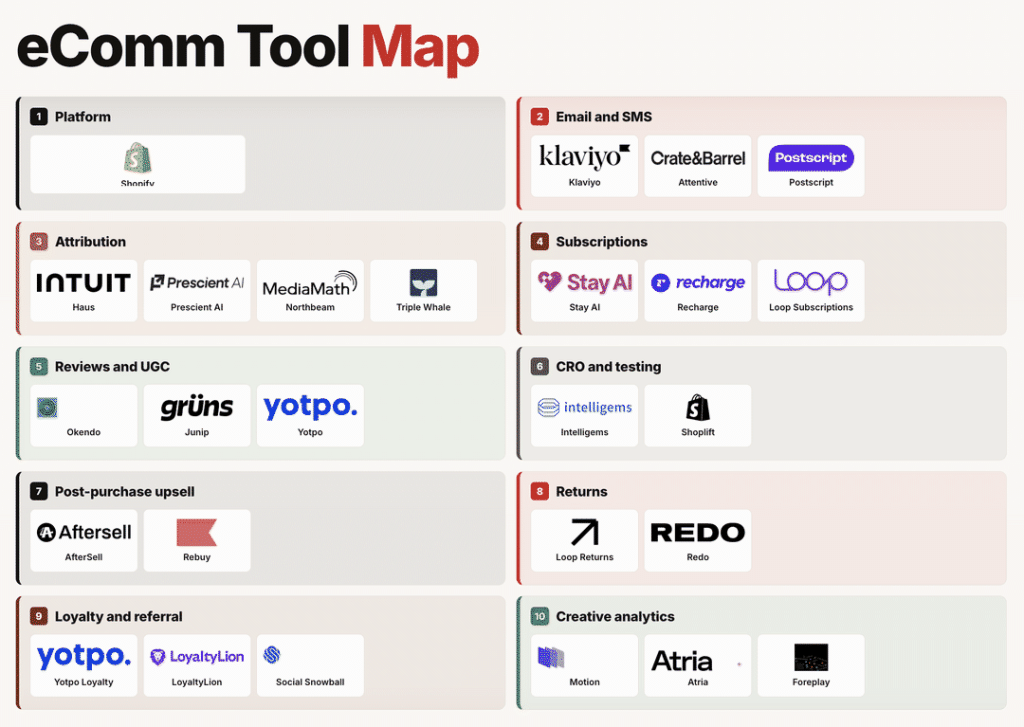
Quick overview: the 10-layer DTC tech stack
| Layer | What it should do | Tools to evaluate |
|---|---|---|
| Platform | Be the single source of truth | Shopify |
| Email & SMS | Drive reconcilable retention revenue | Klaviyo, Attentive, Postscript |
| Attribution | Measure true incrementality | Haus, Prescient AI, Northbeam, Triple Whale |
| Subscriptions | Reduce churn, recover payments | Stay AI, Recharge, Loop Subscriptions |
| Reviews & UGC | Build trust, feed ad creative | Okendo, Junip, Yotpo |
| CRO & testing | Optimize profit per visitor | Intelligems, Shoplift |
| Post-purchase upsell | Raise AOV after checkout | Rokt Aftersell, Rebuy |
| Returns | Keep revenue via exchanges | Loop Returns, Redo |
| Loyalty & referral | Increase repeat purchase and advocacy | LoyaltyLion, Social Snowball, Yotpo |
| Creative analytics | Find winning ads faster | Motion, Atria, Foreplay |
1. Ecommerce platform: start with Shopify
Everything else in your stack depends on your platform’s data quality and app ecosystem. Shopify has the deepest integrations across email, subscriptions, reviews and analytics, and native Shop Pay lifts checkout conversion. If you’re on a platform with a thin app ecosystem, re-platforming is usually the highest-leverage move before you add any other tool.
2. Email and SMS marketing
Retention channels are often your most profitable. What to look for:
- Reconcilable revenue: flow revenue you can match to Shopify orders, not just platform-claimed attribution
- Predictive segments: churn risk, predicted next order date and customer lifetime value (CLV) tiers
- Unified profiles: two-way SMS and compliance records on the same profile as email
Tools: Klaviyo is the default choice with the deepest Shopify data. Attentive suits SMS at scale and enterprise contracts. Postscript is built for Shopify-native SMS programs.
3. Attribution and measurement
Pixel-based multi-touch attribution overstates results, especially after privacy changes. Look for:
- Geo-holdout testing or marketing mix modeling (MMM)
- A first-party pixel with server-side events
- Creative-level reporting with spend tied to each ad
Tools: Haus runs geo-holdout experiments and suits brands spending roughly $100K+ per month. Prescient AI offers daily MMM and covers Amazon and retail. Northbeam combines multi-touch attribution with a geo-lift suite. Triple Whale is dashboard-first and a lower-cost way in.
4. Subscriptions
Recurring revenue only works if you keep subscribers. Prioritize:
- A cancel-save flow with reason capture and tested offers
- Churn-risk targeting and failed-payment recovery
- Native Shop Pay support and a customer portal that reduces support tickets
Tools: Stay AI is a retention specialist. Recharge has the largest ecosystem. Loop Subscriptions competes on lower fees and month-to-month terms.
5. Reviews and user-generated content
Reviews do double duty: they raise conversion and supply ad creative. Look for:
- Attribute-level ratings and filters (skin type, fit, size)
- Syndication to Google Shopping and retail partners
- UGC rights capture, including video, for use in ads
Tools: Okendo (fast widget, Klaviyo-native), Junip (lightweight and fairly priced), Yotpo (the established enterprise option).
6. Conversion rate optimization (CRO) and testing
Don’t limit tests to button colors and layouts. Test price points and shipping thresholds, and judge winners by profit per visitor, not conversion rate alone. A variant that converts more but discounts too deeply can lose money.
Tools: Intelligems is the go-to for price testing. Shoplift handles theme-level A/B tests across product and collection pages.
7. Post-purchase upsell
Offers shown after the card is charged add revenue without risking checkout conversion. Aim for one-click acceptance and rules by cart contents, customer type and AOV band.
Tools: Rokt Aftersell for straightforward post-purchase and checkout blocks. Rebuy for personalization across the whole session.
8. Returns and exchanges
Returns don’t have to mean lost revenue. An exchange-first flow, with bonus store credit as the incentive, keeps money in your business. Keep-the-item logic based on margin avoids paying to ship low-value returns, and return reasons should flow back to your product team.
Tools: Loop Returns is exchange-first. Redo uses a shopper-paid model with no software fee.
9. Loyalty and referral programs
Reward more than orders: points for subscription renewals and reviews build habits. Measure referrals by new-customer revenue, not clicks.
Tools: LoyaltyLion (tiered VIP, strong Klaviyo integration), Social Snowball (referral tied to new-customer revenue), Yotpo Loyalty (enterprise).
10. Creative analytics
With paid social driven by creative, you need to know which hooks, formats and offers actually win. Track spend-weighted ad age and hit rate by concept, and tag hook, format and offer across your whole library.
Tools: Motion for visual creative reporting, Atria for analytics plus a large ad library, Foreplay for swipe files and competitor research.
How to build your stack without overspending
The biggest mistake is buying everything at once. Use this sequence instead:
- Audit what you pay for. List every app, its monthly cost and the revenue or savings it drives.
- Find your biggest profit leak. High churn points to subscriptions. Low repeat rate points to email, SMS and loyalty. Unclear ad performance points to attribution. High return rates point to exchange flows.
- Fix one layer at a time. Implement, measure for 60 to 90 days, then move on.
- Judge tools by profit impact. If you can’t tie a tool to incremental profit, cut it.
- Check integrations first. Confirm the new tool connects cleanly to Shopify and your email platform before you commit.
Frequently asked questions
What is the best tech stack for a Shopify store?
It depends on your stage, but a strong foundation is Shopify, Klaviyo for email and SMS, a reviews app, and one measurement tool. Add subscriptions, upsell and returns tools as your volume and margins justify them.
How much should I spend on ecommerce tools?
Keep software spend proportional to the profit it generates. Add a tool when you can estimate its payback within a few months.
Do I need attribution software?
Once ad spend is meaningful, yes. Platform-reported numbers tend to over-credit themselves, so independent measurement protects your budget.